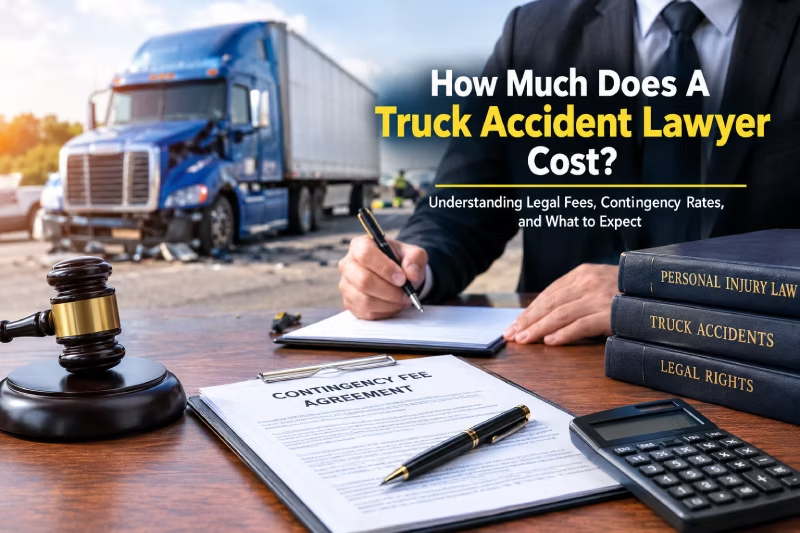
If you have been injured in a commercial truck crash, one of the first questions you may have is how much does a truck accident lawyer cost? In many U.S. truck accident cases, an attorney handles the claim on a contingency-fee basis, meaning you generally do not pay an upfront hourly fee. Instead, the lawyer receives an agreed percentage of the money recovered through a settlement or judgment. The exact percentage, expenses, and payment rules depend on the attorney, the complexity of the case, and the applicable state law.
A truck accident can involve much more than a simple insurance claim. A case may require reviewing the driver's records, trucking-company records, vehicle maintenance documents, electronic logging information, crash evidence, medical records, accident reconstruction, and insurance policies. Because of that, the legal fee should be viewed together with the work required to investigate and pursue the claim.
The American Bar Association explains that contingency fees are commonly used in personal injury matters and are often structured as a percentage of the recovery. The ABA notes that the percentage may commonly fall around one-third to 40%, although the actual arrangement can vary.
How Do Truck Accident Lawyers Usually Charge?
Most personal injury and truck accident lawyers do not use the same billing model as attorneys who charge by the hour for business or family-law matters.
Instead, a truck accident attorney may offer a contingency fee agreement.
Under this arrangement:
- You generally do not pay an upfront attorney retainer.
- The lawyer investigates and handles the claim.
- The lawyer is paid from the recovery if money is obtained.
- The percentage is agreed upon before representation begins.
- The agreement should explain which case expenses are deducted and when.
- If there is no recovery, the attorney may receive no contingency fee, although other expenses can depend on the contract.
For an injured person who is facing medical bills and lost income, this arrangement can make legal representation more accessible.
What Is a Contingency Fee?
A contingency fee means the lawyer's payment depends on the outcome of the case.
For example, suppose an attorney and client agree to a 33⅓% contingency fee. If the case produces a $300,000 recovery, the attorney's fee based on that percentage would be approximately $100,000 before considering any separate case expenses covered by the agreement.
The numbers are only an example. A real fee agreement may use a different percentage, and some agreements use different percentages depending on whether the case settles before a lawsuit, after a lawsuit is filed, or after trial.
This is why a person should not assume that every truck accident attorney charges the same amount.
How Much Is the Typical Truck Accident Lawyer Fee?
There is no single nationwide percentage that every truck accident lawyer must charge.
A commonly encountered contingency-fee range in personal injury matters is roughly one-third to 40% of the recovery, according to the American Bar Association. However, the percentage can be different depending on the lawyer, the state, the fee agreement, and how far the case proceeds.
A fee agreement might look something like this:
| Example fee arrangement | Hypothetical recovery | Attorney fee before expenses |
|---|---|---|
| 30% | $300,000 | $90,000 |
| 33⅓% | $300,000 | $100,000 |
| 35% | $300,000 | $105,000 |
| 40% | $300,000 | $120,000 |
These figures are illustrations, not a nationwide fee schedule.
The percentage alone also does not tell you how much money you will ultimately receive. You need to understand whether litigation expenses, medical liens, expert fees, records charges, and other costs are deducted before or after the attorney's percentage is calculated.
That distinction can materially change the final amount.
Does “No Win, No Fee” Mean You Pay Nothing?
Not necessarily.
This phrase generally refers to the attorney's contingency fee, but it does not automatically mean that every possible case expense disappears if the case is unsuccessful.
For example, a truck accident case may involve expenses such as:
- Court filing fees
- Medical-record charges
- Accident reconstruction
- Expert witnesses
- Deposition expenses
- Court reporter fees
- Document copying
- Crash-scene investigation
- Photographs and video analysis
- Private investigator services
- Other litigation-related expenses
The American Bar Association specifically notes that even with a contingency arrangement, clients may still have responsibility for court filing fees, evidence-gathering costs, and similar charges depending on the agreement.
That is why a person should read the entire fee agreement, rather than relying only on advertising language.
Attorney Fees and Case Expenses Are Not the Same Thing
One of the most important things to understand is the difference between the lawyer's fee and case expenses.
The attorney's fee is what the lawyer receives for providing legal services under the agreed fee arrangement.
Case expenses are costs associated with building and pursuing the claim.
Consider a hypothetical example.
A truck accident victim receives a $500,000 settlement. Suppose the fee agreement provides for a 33⅓% attorney fee. The attorney's fee would be approximately $166,667.
But suppose the case also generated $20,000 in approved litigation expenses.
The final calculation could be different depending on the contract. The agreement might provide that expenses are deducted from the recovery before the contingency percentage is calculated, or it might provide for the attorney's percentage to be calculated first.
Those two methods can produce different net amounts for the client.
The calculation method matters.
A good fee discussion should therefore answer at least three separate questions:
- What percentage does the attorney receive?
- Which expenses are charged to the case?
- When are those expenses deducted?
Why Can a Truck Accident Case Cost More to Handle?
Truck accident claims can require a broader investigation than some ordinary motor vehicle claims.
A large commercial truck may be operated by a driver employed or contracted by a motor carrier. The claim can also involve trucking-company policies, vehicle ownership, maintenance responsibilities, cargo issues, insurance coverage, and federal or state commercial motor vehicle requirements.
Federal Motor Carrier Safety Administration data show that large-truck crashes are a significant category of roadway crashes tracked through federal crash databases. FMCSA's Large Truck and Bus Crash Facts program combines information from sources including NHTSA fatal-crash data, crash sampling data, FMCSA records, and Federal Highway Administration information.
The investigation may therefore extend beyond asking, “Who hit whom?”
An attorney may need to determine:
- What the truck driver was doing before the crash
- Whether the driver was properly licensed and qualified
- Whether hours-of-service rules may be relevant
- Whether the truck was properly maintained
- Whether the carrier followed required safety practices
- Whether the cargo was loaded or secured properly
- Whether another company owned or maintained the vehicle
- Whether multiple insurance policies may apply
- Whether another driver or company contributed to the collision
For example, imagine a tractor-trailer rear-ends a passenger vehicle. At first glance, the case may appear straightforward.
But further investigation could raise additional questions about driver fatigue, braking performance, vehicle maintenance, dispatch practices, visibility, road conditions, or the carrier's conduct.
That additional work is one reason a truck accident case can require substantial legal and investigative resources.
What Factors Can Affect the Lawyer's Fee?
The percentage offered by a lawyer may depend on several factors.
1. Severity of the Injuries
A case involving serious injuries may require extensive medical documentation, expert testimony, future-care analysis, and long-term damages calculations.
2. Complexity of Liability
If several people or companies may share responsibility, the investigation can become more complicated.
For example, potential parties could include:
- The truck driver
- The trucking company
- A vehicle owner
- A maintenance company
- A cargo-loading company
- A manufacturer
- Another motorist
- Other responsible entities
3. Whether a Lawsuit Is Filed
Some cases resolve during negotiations with an insurance company. Others require formal litigation.
Filing a lawsuit can involve additional work, including discovery, depositions, motions, expert witnesses, and court appearances.
The ABA notes that the settlement stage and trial stage can affect the amount of legal work involved, which is one reason fee agreements may distinguish between different stages of a case.
4. Whether the Case Goes to Trial
Trial preparation can require months of additional work.
An attorney may need to prepare witnesses, review expert opinions, develop exhibits, conduct depositions, respond to motions, and prepare for courtroom proceedings.
A fee agreement may therefore provide one percentage for a case resolved before litigation and another percentage if litigation or trial becomes necessary.
5. The Amount at Stake
Cases involving substantial injuries and disputed damages can require significantly more investigation and negotiation than smaller claims.
The lawyer may need to analyze medical treatment, lost wages, diminished earning capacity, property damage, pain and suffering, future medical needs, and other potentially recoverable damages.
What Should You Ask Before Hiring a Truck Accident Lawyer?
Before signing a representation agreement, ask the attorney to explain the fee in plain language.
Useful questions include:
- What percentage of the recovery is your fee?
- Does the percentage change if a lawsuit is filed?
- Does it change if the case goes to trial?
- Who pays investigation expenses?
- Who pays expert-witness fees?
- Are case expenses deducted before or after the attorney fee?
- Will I owe anything if there is no recovery?
- Are medical liens handled by your office?
- Can I receive a written settlement statement showing every deduction?
- What expenses require my approval?
- Are there any charges I could personally owe even if the case does not result in a settlement?
A clear written answer to these questions is more useful than a slogan such as “free consultation” or “no fee unless we win.”
Why the Lowest Percentage Is Not Always the Whole Story
Suppose Lawyer A offers a 30% contingency fee and Lawyer B offers 40%.
It might appear that Lawyer A will automatically leave the client with more money.
But that conclusion cannot be made from the percentage alone.
The two agreements could differ in how expenses are handled, whether the percentage changes after litigation begins, what services are included, and how the attorney handles medical liens or expert costs.
The lawyer's experience with commercial trucking cases may also affect how the case is investigated and presented.
The better approach is to compare the entire fee arrangement, not just one number.
A Simple Way to Understand Your Potential Legal Cost
Think of the final recovery as a pie with several possible deductions.
Gross settlement or judgment
→ Attorney fee
→ Case expenses
→ Medical liens or related repayment obligations
→ Other contractually required deductions
→ Potential amount received by the client
The exact order and treatment of these deductions depend on the case, the fee agreement, applicable law, and any liens or claims against the recovery.
For that reason, an attorney should be able to explain a hypothetical settlement calculation before you agree to representation.
Example
Assume a hypothetical truck accident claim resolves for $600,000.
If the agreed attorney fee were 33⅓%, the fee would be about $200,000. If there were also $15,000 in case expenses, the remaining amount would depend on the contract's calculation method and whether other deductions, such as medical liens, apply.
The important point is that $600,000 is not necessarily the amount the injured person takes home.
Understanding that distinction early can prevent unpleasant surprises later.
Clear Answers Matter More Than Legal Jargon
People researching attorney fees often want a direct answer before reading a long explanation.
That is why this article uses question headers, concise answer writing, tables, and short explanatory sections. These approaches support snippet-friendly formatting, including paragraph snippet optimization, list snippet optimization, and table snippet formatting.
However, there is no guaranteed formula for obtaining a featured snippet or position zero ranking. Search results can change, and Google says there are no special additional technical requirements for appearing in AI Overviews beyond being eligible for normal Search and following its fundamental SEO practices.
The goal should therefore be to answer the reader's question clearly first.
A useful answer is more important than snippet bait content.
That principle also applies to broader SEO work involving featured snippet types, question header optimization, and efforts to improve a page's snippet win rate. These are useful publishing concepts, but they should support the reader rather than replace accurate legal information.
What Additional Costs Can Come With a Truck Accident Claim?
The attorney's contingency fee is only one part of the financial picture. A serious truck accident claim can require money to be spent on investigation, evidence collection, expert analysis, medical records, court filings, depositions, and other services.
These expenses are often called case costs, litigation expenses, or case-related expenses.
The important question is not simply whether these costs exist. It is who pays them, when they are paid, and whether they are deducted from the final recovery.
A well-written representation agreement should explain this clearly.
For example, an attorney may advance certain expenses while the case is pending and recover those amounts from the eventual settlement. Another agreement may require the client to pay particular expenses directly. The arrangement can vary significantly from one law firm to another.
What Expenses May Be Charged in a Truck Accident Case?
The exact expenses depend on the facts of the collision and the amount of investigation required.
Common examples include:
- Accident reports and related records
- Medical records and medical bills
- Court filing fees
- Deposition expenses
- Court reporter charges
- Expert witness fees
- Accident reconstruction
- Vehicle inspections
- Truck inspections
- Photographs and video analysis
- Private investigator fees
- Document retrieval
- Trial exhibits
- Expert testing
- Travel related to litigation
- Other reasonable case expenses
Not every case requires every expense.
A relatively straightforward claim may settle after the lawyer obtains medical records, evaluates liability, negotiates with the insurer, and documents the client's damages.
A disputed commercial trucking case may require substantially more work.
Example: A Disputed Truck Crash
Imagine a passenger vehicle is struck by a tractor-trailer at an intersection.
The truck driver says the passenger vehicle entered the intersection improperly. The injured driver says the truck ran the red light.
There are no clear eyewitnesses.
Now the attorney may need to obtain:
- Traffic-camera footage
- Dash-camera footage
- Event-data information where available
- Police evidence
- Photographs
- Vehicle damage evidence
- Driver records
- Electronic records from the commercial vehicle
- Witness statements
- Accident-reconstruction analysis
The legal expense can increase because liability itself is disputed.
How Much Does an Accident Reconstruction Expert Cost?
There is no universal national price for accident reconstruction.
The cost depends on the expert's experience, the complexity of the collision, the amount of evidence, whether testing is required, and whether the expert ultimately needs to testify.
An accident reconstruction expert may examine:
- Vehicle damage
- Skid or tire marks
- Vehicle positions
- Roadway geometry
- Event data
- Video evidence
- Vehicle speeds
- Reaction times
- Visibility
- Collision angles
- Driver actions
- Physical evidence from the scene
In a serious truck collision, the expert may also need to understand the characteristics of a tractor-trailer, including its size, weight, braking system, stopping distance, and handling.
That analysis can become important when the parties disagree about how the crash occurred.
The expert's bill is generally a case expense, not automatically part of the attorney's contingency percentage. The representation agreement should explain whether such costs are advanced by the law firm and later reimbursed from the recovery.
Why Expert Witnesses Can Matter in a Truck Accident Case
A truck accident case may involve technical questions that cannot be answered simply by looking at a police report.
For example, an expert may be asked whether a truck could reasonably have stopped before striking another vehicle.
Another expert may analyze whether a component failed because of improper maintenance.
A medical expert may address whether an injury is consistent with the collision and whether additional treatment is likely.
An economist or vocational expert may become relevant when the injury affects the victim's future ability to work.
These experts can be expensive, but their role is different from the lawyer's role.
The lawyer presents the legal case.
The expert provides specialized analysis.
That distinction is important when reviewing a settlement statement because expert fees may appear separately from attorney fees.
What Happens to Legal Fees if the Case Goes to Trial?
A truck accident claim that settles quickly may require substantially less attorney time than a case that proceeds through litigation and trial.
If a lawsuit is filed, the lawyer may need to:
- Prepare and file the complaint.
- Respond to the defendant's filings.
- Conduct discovery.
- Request documents.
- Review trucking records.
- Take depositions.
- Defend the client's deposition.
- Hire and prepare experts.
- Attend hearings.
- Prepare motions.
- Negotiate with defense counsel.
- Prepare exhibits.
- Prepare witnesses.
- Develop trial strategy.
- Present the case in court.
Because the workload can increase significantly, some contingency agreements use different percentages at different stages of litigation.
For example, a hypothetical agreement might provide one percentage if the case resolves before a lawsuit and a higher percentage after litigation begins.
That does not mean every lawyer uses this structure.
It means the client should ask before signing.
Why the Fee May Increase After Filing a Lawsuit
Consider two hypothetical cases.
In Case A, the trucking company's insurer accepts liability and offers a settlement after the lawyer presents medical records and supporting evidence.
In Case B, the insurer denies responsibility. The lawyer files a lawsuit, takes depositions, hires an accident reconstruction expert, reviews extensive company records, and prepares for trial.
The amount of attorney work in Case B may be far greater.
That is one reason a fee agreement may distinguish between a pre-litigation recovery and a recovery obtained after litigation begins.
Does a Truck Accident Lawyer Get Paid Before the Client?
Usually, the contingency fee is tied to the recovery rather than being paid as an upfront hourly charge.
However, the exact timing depends on the agreement.
A typical contingency arrangement may work broadly like this:
Investigation → claim or lawsuit → settlement or judgment → deductions → attorney fee and expenses → remaining recovery
The actual sequence can vary.
A client should not assume that the settlement check simply arrives and the attorney automatically takes a percentage from it without accounting for other obligations.
There may be medical liens, health-insurance reimbursement claims, Medicare or Medicaid-related issues where applicable, or other claims against the recovery.
These matters need to be addressed as part of the settlement process.
How Do Medical Bills and Liens Affect the Amount You Receive?
This is one of the most important issues in a personal injury settlement.
Suppose a truck accident victim receives a $400,000 settlement.
That does not necessarily mean the client receives $400,000 after the case is concluded.
The recovery could potentially be reduced by:
- Attorney fees
- Case expenses
- Medical liens
- Health-insurance reimbursement claims
- Other legally enforceable claims
- Contractual obligations
The existence and treatment of these deductions depend on the circumstances.
A lawyer should provide a settlement statement or accounting that explains the deductions.
Hypothetical Settlement Example
Assume:
- Settlement: $400,000
- Contingency fee: 33⅓%
- Attorney fee: approximately $133,333
- Case expenses: $12,000
Before considering any medical liens or other claims, approximately $254,667 would remain.
This is only an illustration.
If the client has substantial outstanding medical claims, the actual amount received could be lower.
The example demonstrates why asking only, “What percentage do you charge?” does not provide the complete financial picture.
Can a Lawyer Negotiate Medical Bills?
In some cases, an attorney may negotiate outstanding medical bills or liens as part of resolving the claim.
Whether the lawyer can reduce a particular bill depends on the type of claim, the provider or lienholder, applicable law, insurance arrangements, and the facts of the case.
Suppose a victim has accumulated $100,000 in medical charges after a serious truck collision.
The settlement is $500,000.
If the lawyer simply calculates the contingency fee without addressing medical claims, the client's final recovery could be substantially affected.
An experienced personal injury lawyer may review the medical charges and applicable claims as part of the settlement process.
The client should ask:
- What medical bills are still outstanding?
- Are any medical liens asserted?
- Does health insurance have a reimbursement claim?
- Will the law firm negotiate those claims?
- Are there additional obligations that must be paid from the settlement?
These questions should be addressed before the settlement is finalized.
What Does a $500,000 Truck Accident Settlement Look Like?
Consider another hypothetical example.
Suppose an injured person settles a truck accident claim for $500,000.
Assume the representation agreement calls for a 33⅓% contingency fee.
The attorney fee would be approximately:
$500,000 × 33⅓% = $166,667
Now assume case expenses total $18,000.
That would leave approximately:
$500,000 − $166,667 − $18,000 = $315,333
But this still does not necessarily represent the client's final recovery.
If there are valid medical liens or other reimbursement obligations, those could further affect the amount.
The example is intentionally simple because real settlement accounting can become much more complicated.
What If the Settlement Is $1 Million?
The same basic principle applies to a larger recovery.
Suppose the agreed contingency fee is 35%.
A hypothetical $1 million recovery would produce:
$1,000,000 × 35% = $350,000
If approved case expenses totaled $25,000, the remaining amount before other deductions would be approximately $625,000.
Again, this is not a prediction of what any particular truck accident case is worth.
The value of a personal injury claim depends on factors such as liability, injury severity, medical treatment, lost income, future damages, evidence, applicable law, available insurance coverage, and other case-specific facts.
Can Truck Accident Lawyers Charge Hourly Fees Instead?
They can, depending on the attorney and the nature of the legal representation, but personal injury matters are commonly handled through contingency arrangements.
Hourly billing means the client pays for attorney time according to an agreed hourly rate.
For example, an attorney might charge a specified amount for each hour spent reviewing documents, communicating with insurers, researching legal issues, attending meetings, or performing other legal work.
That arrangement can create a different financial risk for an injured person because legal bills may accumulate even before the case produces a recovery.
A contingency arrangement shifts much of that payment risk because the attorney's primary fee is generally tied to the outcome.
The specific terms still matter.
What Does a Written Fee Agreement Usually Explain?
A written representation agreement should give the client a clear understanding of the financial arrangement.
Look for provisions addressing:
- Contingency percentage
- Litigation-stage changes
- Case expenses
- Expert witness costs
- Court costs
- Medical liens
- Settlement authority
- Client responsibilities
- Payment timing
- Termination of representation
- What happens if there is no recovery
The American Bar Association recommends that clients understand the fee arrangement and expenses before hiring a lawyer. Written agreements are especially important because they give both sides a clear record of the financial terms. (americanbar.org)
Can You Negotiate a Truck Accident Lawyer's Fee?
Sometimes.
A contingency fee is a contractual arrangement, so there may be room to discuss the terms before representation begins.
However, whether a lawyer will change the percentage depends on the attorney, the case, the expected workload, the jurisdiction, and other factors.
A client can reasonably ask:
“Is the percentage different if the case settles before a lawsuit is filed?”
Another useful question is:
“How are case expenses calculated?”
And:
“If I receive a settlement offer, can you show me an estimated net recovery after fees and expenses?”
These questions are more useful than simply asking whether the lawyer is “cheap.”
What Should You Compare When Looking at Different Lawyers?
When speaking with several attorneys, create a simple comparison.
| Question | Lawyer A | Lawyer B | Lawyer C |
|---|---|---|---|
| Initial consultation | Ask | Ask | Ask |
| Contingency percentage | Ask | Ask | Ask |
| Percentage after filing suit | Ask | Ask | Ask |
| Trial-stage percentage | Ask | Ask | Ask |
| Case expenses | Ask | Ask | Ask |
| Expert costs | Ask | Ask | Ask |
| Medical lien assistance | Ask | Ask | Ask |
| Written fee agreement | Ask | Ask | Ask |
This is more informative than comparing percentages alone.
Two attorneys charging different percentages may have very different arrangements concerning expenses and litigation.
Why Trucking Records Can Increase the Work Involved
Commercial trucking cases can require careful evidence preservation.
Depending on the facts, relevant evidence may include:
- Driver qualification information
- Driver logs
- Electronic logging data
- Inspection records
- Maintenance records
- Dispatch information
- Cargo information
- Bills of lading
- Vehicle inspection information
- Training records
- Accident reports
- Communications
- Video footage
Federal regulations governing commercial motor carriers cover areas such as driver qualifications, hours of service, vehicle inspection, maintenance, and related safety requirements. The FMCSA publishes the Federal Motor Carrier Safety Regulations and related regulatory information for carriers and drivers. (fmcsa.dot.gov)
Not every record will be relevant to every collision.
But when evidence from several sources must be identified, preserved, obtained, reviewed, and analyzed, the legal work can become extensive.
Why Early Investigation Can Matter
Evidence can become harder to obtain as time passes.
Video may be overwritten.
Vehicles may be repaired.
Physical evidence can change.
Witness memories can become less precise.
Commercial records may also be maintained through systems with retention periods that vary depending on the type of information.
That is one reason an attorney may begin investigating a serious truck accident soon after being retained.
The purpose is not simply to increase legal expenses.
The purpose is to preserve evidence that may be important to proving liability and damages.
How Insurance Coverage Can Affect a Truck Accident Case
Commercial trucking cases may involve substantial insurance coverage, but the existence and amount of available coverage depend on the particular parties, vehicles, operations, policies, and applicable requirements.
Federal regulations establish minimum financial responsibility requirements for certain motor carriers and operations, with requirements varying according to the type of operation and cargo involved. FMCSA provides federal information concerning financial responsibility and insurance requirements. (fmcsa.dot.gov)
A case can become more complicated when multiple insurance policies potentially apply.
For example, there may be questions involving:
- The trucking company
- A vehicle owner
- A motor carrier
- A broker
- A leasing company
- Another involved motorist
- A manufacturer or maintenance provider
The exact insurance structure must be investigated rather than assumed.
Does a Higher Lawyer Fee Mean a Better Lawyer?
No conclusion about the quality of legal representation can be drawn from a contingency percentage alone.
A lawyer charging 30% is not automatically better than one charging 40%, and the reverse is also true.
The fee is only one part of the representation agreement.
Other factors a prospective client may want to understand include:
- Experience handling commercial truck cases
- Who will actually handle the file
- Available resources for investigation
- Experience with serious injury claims
- Litigation experience
- Communication practices
- Approach to evidence preservation
- Experience with experts
- Fee and expense structure
- The lawyer's explanation of potential risks
The goal of comparing attorneys should be to understand what representation you are actually receiving and what it will cost.
What If You Cannot Afford the Case Expenses?
This is an important question to raise during the consultation.
Some personal injury firms advance certain litigation expenses and seek reimbursement from the recovery. Others may have different arrangements.
Do not assume.
Ask directly:
“Will I personally have to pay any case expenses while my claim is pending?”
Then ask:
“If there is no recovery, will I owe the firm for expenses it advanced?”
The answers should appear in the written agreement.
A Practical Fee-Comparison Checklist
Before hiring a truck accident lawyer, consider asking for clear answers to these questions:
- What is your contingency percentage?
- Does the percentage change after filing suit?
- Does it change before or during trial?
- Who pays expert witnesses?
- Who pays court costs?
- Who pays for accident reconstruction?
- Are expenses deducted before or after the contingency fee?
- What happens if the case produces no recovery?
- Are medical liens handled?
- Will I receive a written settlement accounting?
- Who will actually handle my case?
- Will I be charged for routine administrative expenses?
- Can I review the complete fee agreement before signing?
Taking a few minutes to understand these provisions can prevent confusion later.
The most important number is not always the advertised percentage.
It is the net amount the client may receive after all applicable fees, expenses, liens, and other obligations are accounted for.
How Should You Compare Truck Accident Lawyers?
Comparing truck accident lawyers requires more than looking at the percentage listed in a contingency-fee agreement.
A lower percentage may look attractive, but the agreement could contain different provisions concerning litigation, expert witnesses, case expenses, medical liens, or the point at which the percentage changes. A higher percentage could also involve a different level of litigation work or a different expense arrangement.
The better approach is to compare the complete representation agreement.
The Federal Trade Commission advises consumers to get the lawyer's fee agreement in writing and understand what the agreement covers and what the client may have to pay. It also explains that contingency arrangements can involve case expenses such as depositions, expert witnesses, and filing fees.
Compare These Five Things
When speaking with attorneys, consider comparing:
- The contingency percentage
- When the percentage changes
- How expenses are handled
- What services the fee covers
- What happens if the case does not produce a recovery
This gives you a much clearer picture than comparing a single percentage.
For example, Lawyer A might charge 33⅓% before litigation and 40% after filing a lawsuit. Lawyer B might use a different structure but advance certain expenses. Lawyer C may have another arrangement altogether.
The important question is not which number looks smallest.
It is what the entire agreement means for your case.
What Are Red Flags in a Truck Accident Fee Agreement?
A fee agreement should not leave you guessing about basic financial terms.
Consider asking for clarification if the agreement does not clearly explain:
- The contingency percentage
- Whether the percentage changes
- How expenses are calculated
- Who pays expert witnesses
- Who pays filing fees
- Whether expenses are deducted before or after the attorney fee
- What happens if there is no recovery
- Whether you can owe expenses even if the case is unsuccessful
- What happens if you change lawyers
- How the final settlement accounting will be provided
The American Bar Association's Model Rule 1.5 states that a contingent-fee agreement should be in writing and should identify the percentage or percentages applicable to settlement, trial, or appeal, as well as litigation expenses and whether those expenses are deducted before or after the contingency fee is calculated. State-specific professional-conduct rules may differ, so the rules applicable to the particular representation should be checked.
Be Careful With Vague Statements
A statement such as “You pay nothing unless we win” may not answer every financial question.
It may refer specifically to the attorney's contingency fee.
There could still be provisions concerning case expenses, medical liens, or other financial obligations.
Instead of relying on advertising language, ask the lawyer to explain the agreement with a hypothetical settlement.
For example:
“If my case settles for $500,000, what would the estimated deductions look like under this agreement?”
That question can reveal much more than a general promise about fees.
What Happens if You Fire Your Truck Accident Lawyer?
This is another issue to understand before signing an agreement.
A client may have rights concerning termination of an attorney-client relationship, but changing lawyers during an active personal injury case can create financial and procedural complications.
Depending on the circumstances, the original lawyer may claim compensation for work already performed or seek reimbursement for expenses advanced. The exact rules can depend on the fee agreement, state law, the reason for termination, whether another attorney takes over, and whether a recovery ultimately occurs.
If you are unhappy with your attorney, do not simply stop communicating.
First review the agreement and ask:
- What does the contract say about termination?
- What happens to expenses already advanced?
- What happens if another lawyer takes over?
- Is court approval necessary in the particular situation?
- How will any disputed fee be handled?
The FTC notes that clients may have the ability to fire a lawyer, although circumstances can differ and court permission may sometimes be relevant.
Does the State Where the Truck Accident Happened Matter?
Yes.
Truck accident claims can involve federal regulations, state law, insurance rules, statutes of limitation, negligence standards, damages rules, and professional-conduct requirements.
A contingency-fee structure that is common in one state may not operate identically in another.
The lawyer should determine which jurisdiction's law applies to the claim and explain any important state-specific rules.
This is especially important when an accident involves interstate trucking.
For example, a tractor-trailer may travel through several states, while the crash occurs in only one state. The trucking company may be based somewhere else, and the injured person's residence may be different again.
That can create questions about jurisdiction, applicable law, filing deadlines, and the parties that may potentially be responsible.
Why Truck Insurance Coverage Can Make a Case More Complicated
Insurance coverage is another reason truck accident cases can require substantial investigation.
Federal Motor Carrier Safety Administration rules establish financial-responsibility requirements for certain motor carriers, but the requirements depend on factors such as the type of carrier, vehicle, cargo, and operation. FMCSA currently lists different minimum requirements for various commercial operations.
For example, FMCSA lists a $750,000 minimum public-liability limit for certain for-hire interstate property carriers operating vehicles with a gross vehicle weight rating of 10,001 pounds or more when transporting non-hazardous property. Different requirements can apply to hazardous materials and other operations.
These federal minimums should not be mistaken for the actual amount of insurance available in every accident.
A particular trucking company may have insurance coverage that is greater than the federal minimum, and other potentially applicable policies may exist depending on the business structure and circumstances.
A lawyer may therefore need to investigate:
- The motor carrier's insurance
- Additional liability coverage
- Vehicle ownership
- Leasing arrangements
- Broker relationships
- Cargo relationships
- Other potentially responsible parties
- Applicable federal and state requirements
The available insurance can affect settlement negotiations, but insurance limits do not automatically determine the value of an injury claim.
What Is the Difference Between a Settlement and a Judgment?
A settlement is an agreement between the parties that resolves a dispute.
A judgment is a court's formal decision following litigation.
Most personal injury cases resolve through settlement rather than a trial, but every case is different.
From a fee perspective, the representation agreement should explain what percentage applies if the matter settles and what percentage, if any, applies if the case proceeds through trial or appeal.
The ABA Model Rule specifically identifies settlement, trial, and appeal when describing what a written contingent-fee agreement should address.
This is another reason to read the agreement carefully.
What Questions Should You Ask During a Free Consultation?
A free consultation does not mean you should walk into the meeting without questions.
Consider bringing a written checklist.
Questions About Fees
Ask:
- What percentage do you charge?
- Does that percentage change if a lawsuit is filed?
- Does it change if the case goes to trial?
- How are case expenses handled?
- Do you advance those expenses?
- What happens if there is no recovery?
- Could I owe expenses even if the case is unsuccessful?
- Are expenses deducted before or after your percentage?
Questions About the Case
Ask:
- Who will investigate the crash?
- Who will communicate with the insurance company?
- Who will handle depositions?
- Who will handle trial if the case reaches court?
- Do you use accident reconstruction experts?
- How are medical records evaluated?
- How are future damages calculated?
- How will evidence from the trucking company be preserved?
Questions About Communication
Ask:
- Who will be my primary contact?
- How will updates be provided?
- How quickly should I expect responses?
- Will I speak directly with the attorney handling the case?
These questions can help you understand the actual service you are receiving.
What Should You Bring to a Truck Accident Lawyer?
The more useful information you can provide at the first consultation, the easier it may be for the attorney to understand the basic facts.
Consider bringing or providing copies of:
- Police or crash reports
- Photographs
- Videos
- Insurance information
- Medical records
- Medical bills
- Prescription information
- Employer information
- Wage-loss documentation
- Witness information
- Vehicle-damage photographs
- Correspondence from insurance companies
- Settlement offers
- Information about the truck and trucking company
- Any communications relating to the accident
Do not worry if you do not have everything.
An attorney can tell you what additional records may be needed.
Should You Talk to the Trucking Company's Insurance Company?
An insurance adjuster may contact an injured person shortly after a collision.
You should understand that the adjuster works for the insurance company, not for you.
A settlement offer should not automatically be accepted simply because it arrives quickly.
Serious truck accident injuries may require substantial treatment, and the full effect of an injury may not be immediately known.
Before signing a release or accepting a settlement, consider obtaining legal advice about the claim, particularly when injuries are serious or liability is disputed.
How Do You Calculate the Real Cost of a Truck Accident Lawyer?
The simplest way to think about legal cost is:
Attorney fee + case expenses + other applicable deductions = total reduction from the recovery
Then:
Gross recovery − applicable deductions = potential net recovery
For example, assume a hypothetical $750,000 settlement.
Suppose the contingency fee is 35%.
The attorney fee would be:
$750,000 × 35% = $262,500
Assume case expenses total $20,000.
The amount remaining before other deductions would be:
$750,000 − $262,500 − $20,000 = $467,500
If the client also has valid medical liens or reimbursement obligations, the final amount could be lower.
This calculation demonstrates why consumers should ask for an explanation of every anticipated deduction.
What If the Lawyer Charges 40%?
A 40% contingency fee would mean that a $500,000 recovery produces a hypothetical attorney fee of $200,000 before applicable expenses.
But that number does not tell you whether the arrangement is reasonable, because fee reasonableness depends on the circumstances and applicable rules.
The ABA Model Rule 1.5 identifies factors including the time and labor required, difficulty of the matter, customary fees in the locality, amount involved, time limitations, experience of the lawyer, and whether the fee is fixed or contingent.
State rules may impose additional requirements or restrictions.
Therefore, there is no responsible nationwide rule saying that a particular percentage is automatically appropriate for every truck accident case.
Can the Contingency Percentage Be Negotiated?
It may be negotiable.
The FTC specifically notes that consumers may be able to negotiate the size of a contingency fee and that an agreement may use different percentages depending on how quickly the case settles or whether litigation becomes necessary.
A prospective client can ask whether the attorney offers:
- A lower percentage for early settlement
- A staged percentage
- A different percentage for litigation
- A different arrangement for expenses
- Another fee structure appropriate to the case
There is no guarantee that the lawyer will agree to changes.
The important point is that the terms can be discussed before the agreement is signed.
What Should You Do Before Signing a Fee Agreement?
Before signing, read the document from beginning to end.
Do not focus only on the percentage.
Look for the answers to these questions:
What happens if I win?
What happens if I lose?
What expenses will be deducted?
When are those expenses deducted?
Does the percentage change?
Who pays experts?
Who handles medical liens?
What happens if I terminate the relationship?
What happens if the lawyer withdraws?
Will I receive a final written accounting?
The ABA Model Rule provides that a contingent-fee agreement should explain expenses and their treatment, and that a written statement should be provided at the conclusion of a contingent-fee matter showing the outcome and, where there is a recovery, how the client's remittance was calculated.
How Search-Friendly Legal Content Can Answer Fee Questions Clearly
Someone searching for legal costs generally does not want to read several paragraphs before finding the basic answer.
That is why the article uses question header optimization, direct explanations, tables, examples, and short lists.
For example, the question “How much does a truck accident lawyer charge?” can be answered immediately, followed by the details needed to understand why the actual fee may differ.
This is an example of concise answer writing combined with useful supporting information.
A short paragraph can potentially serve users who want a quick answer. A table can help someone compare hypothetical calculations. A list can help someone prepare for a consultation.
These methods support snippet-friendly formatting, including paragraph snippet optimization, list snippet optimization, and table snippet formatting.
But no legitimate content strategy can promise a featured snippet, position zero ranking, or a particular snippet win rate.
Google's current guidance for AI features similarly emphasizes that there are no special additional requirements for appearing in AI Overviews or AI Mode. Pages should meet Google's normal technical and content requirements and provide useful, unique value.
The practical lesson is simple:
Write for the person first.
Search visibility should follow from genuinely useful information rather than artificial snippet bait content.
Truck Accident Lawyer Cost Checklist
Before hiring an attorney, use this checklist.
Fee Checklist
- Get the agreement in writing.
- Identify the contingency percentage.
- Ask whether the percentage changes.
- Ask when the percentage changes.
- Ask how expenses are calculated.
- Ask who pays expert witnesses.
- Ask who pays filing and deposition costs.
- Ask what happens if there is no recovery.
- Ask whether you could owe expenses after an unsuccessful case.
Case Checklist
- Ask who investigates the collision.
- Ask how evidence will be preserved.
- Ask who communicates with insurers.
- Ask who handles depositions.
- Ask who handles trial.
- Ask whether experts may be necessary.
- Ask how future medical expenses are evaluated.
- Ask how lost wages and future earning losses are calculated.
Settlement Checklist
- Ask how attorney fees are calculated.
- Ask how case expenses are deducted.
- Ask whether medical liens will be addressed.
- Ask whether health-insurance reimbursement claims may exist.
- Ask for a written settlement accounting.
- Review the proposed settlement before signing a release.
A Final Example: Comparing Two Hypothetical Fee Agreements
Suppose two attorneys offer to represent the same hypothetical client.
Attorney A
- 33⅓% before litigation
- 40% after litigation begins
- Client expenses advanced by the firm
- Expenses deducted according to the written agreement
Attorney B
- 35% throughout the case
- Different treatment of case expenses
- Different terms concerning expert costs
At first glance, Attorney A appears less expensive because the initial percentage is lower.
But that comparison is incomplete.
If the case requires litigation, the percentage could change. If the two agreements treat expenses differently, the final net recovery could also differ.
The client should therefore request a hypothetical calculation under each agreement.
For example:
“Assume the case settles for $600,000 after a lawsuit is filed. Show me exactly how the settlement would be distributed.”
That single exercise can make complicated fee language much easier to understand.
Key Takeaways About Truck Accident Lawyer Costs
The cost of hiring a truck accident lawyer is usually based on the specific fee agreement, not on a universal national price.
The most important points are:
- Many personal injury lawyers use contingency fees.
- You may not have to pay an upfront attorney fee under a contingency arrangement.
- The percentage varies.
- Some agreements use different percentages at different stages.
- Case expenses are separate from the attorney's fee in many agreements.
- Expert witnesses and accident reconstruction can create additional expenses.
- Medical liens can reduce the amount ultimately received.
- Insurance coverage should be investigated rather than assumed.
- State law can affect both fees and the underlying claim.
- The written agreement is more important than an advertising slogan.
- You should understand the calculation before signing.
- Ask for a hypothetical settlement breakdown.
- Do not compare lawyers solely by contingency percentage.
For serious truck accident claims, the financial arrangement should be clear before representation begins.
Conclusion: Understand the Fee Before You Hire the Lawyer
The cost of a truck accident lawyer is usually easier to understand once you separate the lawyer's fee from the other financial issues surrounding the case. Many personal injury attorneys use contingency arrangements, so an injured person may be able to obtain legal representation without paying an upfront attorney fee. The lawyer's compensation is generally tied to the recovery, but the percentage and treatment of expenses can vary.
The most important number is therefore not necessarily the percentage printed in an advertisement.
It is the complete financial arrangement.
Before hiring a lawyer, understand the contingency percentage, whether it changes during litigation, how case expenses are handled, whether expert costs are advanced, what happens if there is no recovery, and how medical liens or other claims can affect the final amount.
For truck accident cases, the investigation may involve multiple parties, commercial trucking records, federal motor-carrier requirements, insurance policies, expert analysis, and substantial medical evidence. FMCSA's current materials confirm that federal financial-responsibility requirements vary according to the type of carrier, vehicle, cargo, and operation, which is one reason insurance issues should be investigated rather than assumed.
A written agreement should give you a clear understanding of the fee and expenses. The ABA Model Rule 1.5 framework calls for contingent-fee agreements to identify the applicable percentages and explain how litigation expenses are treated, although the specific rules governing a lawyer-client relationship are determined by the applicable jurisdiction.
If you are considering legal representation after a serious truck collision, take time to ask direct questions and read the agreement before signing it.
Know the percentage. Know the expenses. Know the possible deductions. Know what you may receive after the case is resolved.
That is the clearest way to understand what hiring a truck accident lawyer may actually cost.
Frequently Asked Questions (FAQs)
How much does a truck accident lawyer typically charge?
Many personal injury lawyers use contingency fees, meaning the attorney receives an agreed percentage of the recovery instead of charging the client an hourly fee upfront. The exact percentage varies by lawyer, case, stage of litigation, and state law. The FTC notes that there is no single standard contingency percentage and that consumers should understand the written agreement before signing.
Do I have to pay a truck accident lawyer upfront?
Often, a personal injury lawyer handling a truck accident claim on contingency does not require the client to pay an upfront attorney retainer. However, case expenses can be treated separately. Depending on the agreement, expenses may be advanced by the law firm and later deducted from a recovery, or the client may have other responsibilities.
What happens if I lose my truck accident case?
If the agreement is truly contingent, the lawyer generally does not receive the contingency attorney fee if there is no recovery. However, the client may still be responsible for certain case expenses depending on the written agreement and applicable law. This is one of the most important questions to ask before hiring the lawyer.
Do truck accident lawyers charge more if the case goes to trial?
They may.
Some fee agreements use different contingency percentages depending on whether the case settles before litigation, after a lawsuit is filed, or after trial preparation begins. The actual arrangement must be stated in the representation agreement.
Who pays expert witnesses in a truck accident case?
It depends on the fee agreement.
Expert witnesses may include accident reconstruction specialists, medical experts, vocational experts, economists, or other specialists. Their fees are generally treated as case expenses rather than automatically being included within the lawyer's contingency percentage.
Can I negotiate a lawyer's contingency fee?
Potentially, yes.
The FTC notes that contingency fees may be negotiable and that lawyers may use different percentages based on the amount of work required.
A prospective client can ask whether the attorney will offer a different structure, but the attorney is not required to agree to a requested percentage.
Is a 33% contingency fee expensive?
A 33% contingency fee means the attorney would receive approximately one-third of the recovery under that agreement before considering how case expenses are handled.
Whether a particular fee is reasonable depends on the circumstances, the work involved, applicable law, and the terms of the agreement. The percentage should not be evaluated without examining the complete fee structure.
Is a 40% contingency fee normal?
A 40% contingency fee can appear in some personal injury agreements, but there is no single nationwide percentage that applies to every truck accident case.
The applicable state rules and the individual representation agreement matter.
Does the lawyer's percentage come out before medical bills?
Not necessarily.
The treatment of medical bills, liens, and other expenses can vary. The fee agreement should explain how case expenses are handled, and the lawyer should explain how medical claims or liens could affect the final distribution.
Does the lawyer get paid if the insurance company settles the case?
If the attorney has a contingency agreement and obtains a settlement for the client, the lawyer generally receives the agreed contingency fee from the recovery, subject to the terms of the agreement and applicable law.
Can I hire a truck accident lawyer if I have no money?
A contingency arrangement may allow an injured person to obtain representation without paying an upfront attorney fee. The lawyer generally receives the agreed fee from a successful recovery. However, the client should still ask about case expenses and whether any expenses could become the client's responsibility.
How do I know what I will actually receive?
Ask the attorney for a hypothetical settlement statement.
For example:
“If the case settles for $500,000, can you show me the estimated attorney fee, case expenses, medical liens, and the amount that would remain?”
The exact result cannot be known until the case is resolved and all applicable obligations are determined, but a lawyer should be able to explain the basic calculation.
Ready to take the next step?
Use our free tools to estimate your case value, organize evidence, and connect with a vetted attorney.


