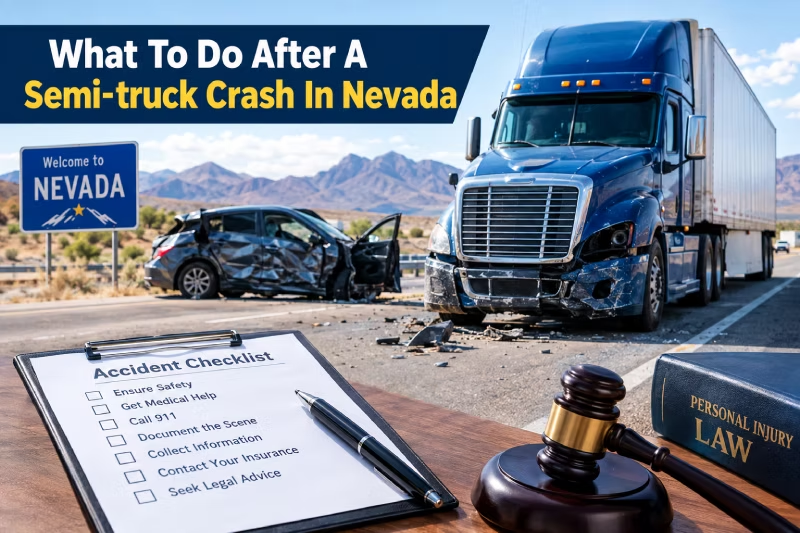
After a serious collision, knowing what to do after a semi-truck crash in Nevada can make a major difference in your safety, medical care, evidence, insurance claim, and potential personal injury case. A crash involving a tractor-trailer can be far more complicated than an ordinary car accident because several parties may be involved, including the truck driver, trucking company, cargo owner, maintenance provider, insurer, and sometimes a vehicle or equipment manufacturer.
This guide explains what to do at the scene, what Nevada law requires, how to protect important evidence, when to seek medical care, how insurance claims work, and what legal deadlines may apply.
A semi-truck collision can happen on Interstate 15 through Las Vegas, I-80 near Reno and Sparks, U.S. 95, U.S. 93, or a smaller Nevada highway. The location may change, but the first priorities remain the same: protect people, report the crash, obtain medical attention, preserve evidence, and avoid statements that could unnecessarily damage a claim.
Federal crash data show why these cases deserve careful attention. FMCSA reported that in 2022 approximately 503,000 police-reported crashes involved large trucks, including about 5,279 fatal crashes and 114,000 injury crashes. FMCSA also reported that 82% of fatalities in large-truck crashes were people who were not occupants of the large truck. (FMCSA)
Nevada's more recent FMCSA data also show that large trucks and buses continue to be involved in hundreds of reportable crashes in the state each year. For example, the agency's August 28, 2026 data snapshot lists 847 large-truck-and-bus crashes in Nevada in 2024, including 29 fatal crashes and 818 nonfatal crashes. Because MCMIS data can remain preliminary for up to 22 months, newer figures can change as records are updated. (FMCSA AI)
What Should You Do Immediately After a Semi-Truck Crash?
The first few minutes are about safety and emergency response, not determining who will ultimately be responsible.
If you are physically able to do so, take the following steps.
- Call 911.
- Request police and emergency medical assistance.
- Move away from traffic if you can do so safely.
- Do not stand between vehicles or in an active traffic lane.
- Do not attempt to approach a damaged truck carrying hazardous materials.
- Exchange required information with the other driver.
- Photograph the scene if it is safe.
- Identify witnesses.
- Seek medical attention for injuries.
- Avoid arguing about fault at the scene.
Nevada law generally requires a driver involved in a qualifying crash to stop. If the vehicle creates a hazard or blocks traffic and can safely be moved, Nevada law provides for moving it to a safe location that does not create a hazard or obstruct traffic. (Nevada Legislature)
Call 911 and Report the Collision
A truck collision should generally be reported to law enforcement, especially when someone is injured, killed, or there is significant property damage.
Under Nevada law, drivers involved in a crash resulting in injury, death, or damage to an attended vehicle or property have duties that include providing identifying information and rendering reasonable assistance to injured people. If no police officer is present, the statute also addresses reporting the crash to the appropriate police authority or Nevada Highway Patrol. (Nevada Legislature)
Do not assume that a minor-looking injury means the collision is minor.
For example, someone may walk away from a rear-end collision involving a semi-trailer believing they are fine, only to experience neck, back, shoulder, or concussion symptoms later. Medical evaluation creates a record of the condition and allows a medical professional to determine whether additional treatment is needed.
Move to Safety When Possible
A damaged passenger vehicle can create a serious secondary-crash risk, particularly on an interstate.
If your vehicle is operable and moving it is safe, get it out of an active lane. If you cannot move it safely, remain in a protected location when possible and follow instructions from law enforcement.
Do not risk another injury simply to take photographs.
A photograph is useful evidence. Your safety is more important.
Get Medical Care Even If You Feel Fine
One of the most common mistakes after a truck collision is assuming that no immediate pain means there is no serious injury.
The force involved in a semi-truck crash can cause injuries that are not immediately obvious. These may include:
- Whiplash and other neck injuries
- Back and spinal injuries
- Traumatic brain injuries
- Broken bones
- Shoulder injuries
- Internal injuries
- Soft-tissue injuries
- Nerve damage
- Psychological effects following a traumatic collision
If emergency personnel recommend transportation to a hospital, take that recommendation seriously.
If you decline an ambulance but later develop symptoms, contact a medical professional promptly and explain that you were involved in a truck collision.
Keep a Complete Medical Record
After the initial examination, follow your doctor's instructions and attend recommended appointments.
Keep copies of:
- Emergency-room records
- Hospital records
- Diagnostic imaging
- Prescription information
- Physical therapy records
- Specialist evaluations
- Medical bills
- Work restrictions
- Disability documentation
- Receipts for accident-related expenses
For example, suppose a driver experiences mild shoulder pain immediately after being struck by a semi. Two days later, the pain becomes severe and an MRI reveals a significant injury. The timeline between the crash, symptoms, medical visit, testing, and diagnosis can become important when determining whether the injury is connected to the collision.
Do not hide symptoms from your doctor.
Tell the medical provider what happened, where you hurt, when symptoms started, and whether the symptoms are getting worse.
Document the Truck Crash Scene
Evidence can disappear quickly after a commercial vehicle collision.
The damaged vehicles may be towed. Road debris may be removed. A truck may be repaired. Cargo may be transferred. Electronic records may eventually be overwritten according to company retention practices.
That is why early evidence preservation matters.
If you are physically capable and it is safe, photograph or record:
- Your vehicle from multiple angles
- The truck and trailer
- License plates
- Truck identification numbers
- Company markings
- Visible damage
- Skid marks
- Road debris
- Lane markings
- Traffic signals
- Road signs
- Weather conditions
- Lighting conditions
- Nearby businesses
- Nearby surveillance cameras
- The surrounding roadway
- Cargo that appears to have shifted or spilled
- Tire damage
- Broken truck components
Do not put yourself in danger to obtain any photograph.
Collect Information From the Truck Driver
Nevada law requires drivers involved in qualifying crashes to provide identifying information, including their name, address, and vehicle registration information, and to provide a driver's license when requested and available. The law also requires reasonable assistance to injured persons when appropriate. (Nevada Legislature)
If possible, record:
- Driver's name
- Driver's license information
- Truck and trailer plate numbers
- Company name
- Carrier identification information
- Insurance information
- Truck number or unit number
- Trailer number
- Witness names and contact information
- Police agency responding to the crash
- Crash or incident number
Do not get into an argument with the truck driver about how the collision happened.
The police investigation, photographs, witness statements, vehicle evidence, electronic records, and other evidence can help establish what occurred.
Why Truck Accident Cases Can Be More Complicated
A typical two-car collision may involve two drivers and their insurance companies.
A commercial truck case can involve multiple potentially responsible parties.
Depending on the circumstances, a claim may involve:
| Potential party | Why they may matter |
|---|---|
| Truck driver | Driving conduct, fatigue, distraction, impairment, training |
| Trucking company | Hiring, supervision, scheduling, policies, maintenance |
| Truck owner | Ownership and maintenance responsibilities |
| Cargo company | Loading, securement, weight distribution |
| Maintenance provider | Repairs, inspections, defective maintenance |
| Manufacturer | Potential equipment or component defects |
| Other motorist | Lane changes, speeding, failure to yield, distraction |
| Government entity | Certain roadway or maintenance issues, depending on facts |
| Insurance companies | Coverage and claim handling |
This does not mean every listed party is legally responsible in every collision.
Determining responsibility requires evidence.
FMCSA's published crash data also illustrate why investigators need to look beyond a simple assumption about fault. In its 2022 data, FMCSA reported that 63% of large trucks involved in fatal crashes had a critical pre-crash event involving another vehicle, person, animal, or object in the truck's lane or encroaching into it, while 24% had a critical pre-crash event involving the truck's own movement or loss of control. These figures are national statistics and do not establish what caused any individual Nevada collision. (FMCSA)
Preserve Evidence Before It Disappears
Truck accident evidence may exist in places that an injured person cannot access independently.
Potential evidence can include:
- Driver logs
- Electronic logging device data
- Dash-camera footage
- Truck GPS information
- Electronic control module data
- Inspection records
- Maintenance records
- Repair records
- Driver qualification records
- Training records
- Employment records
- Drug and alcohol testing records
- Dispatch communications
- Delivery schedules
- Bills of lading
- Cargo-loading records
- Weight records
- Cellphone records where legally obtainable
- Surveillance video
- 911 recordings
- Police reports
- Witness statements
For example, if a truck driver claims that a collision occurred because another vehicle suddenly entered the truck's lane, photographs alone may not answer every question. Camera footage, roadway evidence, vehicle damage patterns, witness accounts, and available electronic data may provide additional information.
This is one reason a commercial truck accident investigation can take considerably more work than an ordinary insurance claim.
Ask About the Police Crash Report
The police report can be an important starting point, but it is not necessarily the final word on civil liability.
Nevada State Police Highway Patrol explains that crash reports can be requested and states that reports are generally available 7–14 days after the crash. The agency lists regional contacts for Las Vegas, Reno, and Elko. (NHP)
Nevada's Department of Transportation also explains that individual crash reports should be obtained from the law-enforcement agency that responded to the collision rather than from NDOT. (Nevada Department of Transportation)
A person reviewing the report should look for:
- Driver statements
- Witness information
- Diagram of the collision
- Officer observations
- Road conditions
- Citations
- Vehicle damage
- Injury information
- Commercial vehicle information
- Statements about possible contributing factors
Do not assume that a citation automatically determines who will win or lose a personal injury claim. Civil liability involves additional evidence and legal issues.
Nevada Crash Reporting Requirements You Should Know
Nevada has specific crash-reporting requirements that can matter after a serious collision.
The Nevada DMV states that crashes involving injuries or damage of $750 or more must be reported to the DMV. If a police officer does not investigate, involved parties generally must file an SR-1 report within 10 days. (Nevada DMV)
Nevada Revised Statutes similarly provide that, subject to listed exceptions, a driver involved in a crash causing bodily injury, death, or apparent total damage of at least $750 must submit a written or electronic report to the Department within 10 days. The statute also provides an exception where a police investigation report contains specified insurance information. (Nevada Legislature)
The important point is simple: do not ignore Nevada's reporting rules because you believe the insurance companies will handle everything.
If you are injured and unable to complete required paperwork, special rules may apply. Nevada administrative regulations also address documentation that may accompany an SR-1 report, including proof of insurance and, in applicable circumstances, a physician's statement concerning injury. (Nevada Legislature)
Dealing With Insurance After a Nevada Semi-Truck Crash
Once the immediate emergency has passed, the next major issue is usually insurance and liability. A trucking collision may involve more than one insurance policy, and the available coverage can depend on who owned the truck, who employed the driver, whether the carrier was operating interstate, and what the driver's role was at the time of the crash.
Nevada requires registered motor vehicles to carry minimum liability coverage of $25,000 for bodily injury or death to one person, $50,000 for two or more people, and $20,000 for property damage. Those are state minimums for covered motor vehicles; they do not mean a commercial carrier's policy is limited to those amounts. (Nevada Legislature)
Commercial trucking policies can involve substantially different coverage arrangements. A carrier may have primary liability coverage, excess or umbrella coverage, and other policies that become relevant depending on the circumstances.
Do Not Assume the First Insurance Offer Is the Full Value of Your Claim
An insurance adjuster's job is to evaluate and resolve claims for the insurer.
That does not automatically make the adjuster an independent evaluator of your long-term financial interests.
A settlement offer may arrive before the full extent of an injury is known. For example, an insurer might offer money shortly after a collision when you have only received emergency treatment and have not yet completed diagnostic testing or physical therapy.
Accepting a settlement generally means giving up further claims covered by the release.
Before signing anything, determine:
- What claims the document releases
- Whether future medical treatment is included
- Whether lost wages are included
- Whether property damage is included
- Whether other potentially responsible parties are released
- Whether medical liens or reimbursement claims remain
- Whether the amount adequately accounts for known losses
Do not rush into a settlement simply because money is offered quickly.
Be Careful When Speaking With the Trucking Company's Insurer
You should provide accurate information when required, but you should also understand what you are being asked.
A recorded statement can become part of the insurance company's claim file. An innocent mistake about the speed of the vehicles, the precise timing of symptoms, or what happened immediately before impact can later become an issue.
You can truthfully say that you do not remember something if you genuinely do not remember it.
Do not guess.
For example, saying "I think the truck was going 70 or 75 mph" is different from saying "I don't know the truck's speed, but it appeared to be traveling much faster than my vehicle."
The second statement more accurately communicates uncertainty.
Notify Your Own Insurance Company
You may need to notify your own insurer even when another driver caused the crash.
Your policy may provide benefits or protections that become relevant, including:
- Medical payments coverage, if applicable
- Uninsured motorist coverage
- Underinsured motorist coverage
- Collision coverage
- Rental or transportation benefits
- Other policy-specific benefits
Your policy controls the exact coverage.
Do not assume that because the truck driver appears to be insured, your own policy is irrelevant.
A commercial carrier's insurer may dispute liability, dispute the amount of damages, or argue that another person caused the collision. Your own policy may become important depending on the facts.
Understand Who May Be Responsible for a Truck Crash
Truck accident liability often requires a broader investigation than simply asking, "Who was driving?"
Consider a hypothetical collision on I-15.
A semi-truck changes lanes and strikes a passenger vehicle. The truck driver says the passenger vehicle moved into the truck's lane. The passenger says the truck moved into the passenger vehicle.
At first, there are two competing accounts.
Now consider additional evidence:
- A dash camera captured the lane change.
- Tire marks show the truck's movement.
- The truck's electronic data provides additional information.
- A witness saw the truck drift across the lane line.
- The carrier's records show the driver had been working for an extended period.
- The trailer was loaded improperly.
The case can change significantly once additional evidence is examined.
Driver Negligence
A truck driver's conduct may become relevant if evidence shows:
- Distracted driving
- Unsafe lane changes
- Following too closely
- Speeding
- Failure to yield
- Fatigue
- Impairment
- Improper turns
- Failure to maintain control
- Violations of applicable safety rules
A traffic citation can be relevant evidence, but a citation by itself does not necessarily resolve every issue in a civil case.
Employer or Carrier Responsibility
The trucking company may become relevant when the evidence concerns:
- Hiring
- Driver qualifications
- Training
- Supervision
- Scheduling
- Dispatch practices
- Maintenance
- Company safety policies
- Regulatory compliance
The exact legal theory depends on the relationship between the driver and company and the facts surrounding the collision.
Cargo Loading and Securement
Cargo can create another layer of investigation.
An improperly loaded trailer can affect:
- Vehicle stability
- Braking
- Steering
- Weight distribution
- Trailer movement
- Stopping distance
If cargo shifted before or during a crash, investigators may need to examine how the load was prepared and secured.
Maintenance and Equipment Problems
A crash may also involve an alleged mechanical problem.
Investigators may examine:
- Brakes
- Tires
- Steering components
- Lights
- Suspension
- Coupling systems
- Trailer equipment
- Preventive maintenance
- Inspection records
If a component failed, determining why it failed can be as important as determining that it failed.
Trucking Records Can Be Critical Evidence
Commercial carriers operate within a detailed federal regulatory system.
One important category is hours-of-service information.
FMCSA states that the electronic logging device rule applies to most commercial drivers who are required to maintain records of duty status, subject to listed exceptions. Motor carriers generally must retain ELD records of duty status and supporting information for six months. (FMCSA)
That retention period makes early investigation particularly important.
A truck accident attorney may seek evidence concerning:
- Hours driven
- Off-duty periods
- On-duty periods
- Driving time
- ELD records
- Supporting documents
- Dispatch information
- Fuel records
- GPS information
- Delivery schedules
FMCSA also explains that original ELD records remain retained even when permitted edits and annotations are made, and that the carrier must provide access to records in certain circumstances. (FMCSA)
This does not mean an injured person automatically receives every trucking record simply by asking the carrier.
Access may depend on the investigation, applicable law, discovery procedures, subpoenas, preservation requests, and other legal processes.
Why a Preservation Letter May Matter
A preservation letter, sometimes called a spoliation or litigation-hold letter depending on its purpose and contents, can formally notify a potentially responsible party that certain evidence should be preserved.
Potential preservation targets can include:
- ELD information
- Dash-camera recordings
- Driver qualification records
- Inspection records
- Maintenance records
- Vehicle data
- GPS information
- Dispatch messages
- Cellphone-related evidence where legally appropriate
- Cargo records
- Surveillance video
The goal is not to demand evidence that does not legally belong to you.
The goal is to reduce the risk that potentially relevant evidence disappears through ordinary business practices.
For example, if a carrier routinely retains certain electronic footage for only a limited period, waiting months before addressing preservation could create an avoidable evidence problem.
Keep Track of Every Financial Loss
A serious semi-truck collision can create financial consequences beyond the hospital bill.
Create a dedicated accident file.
Keep records for:
- Emergency treatment
- Doctor visits
- Surgery
- Medication
- Physical therapy
- Diagnostic testing
- Medical equipment
- Transportation to appointments
- Vehicle repairs
- Vehicle replacement
- Towing
- Rental transportation
- Lost wages
- Missed work
- Reduced work capacity
- Household services
- Other documented accident-related expenses
A simple spreadsheet can help.
| Category | What to save |
|---|---|
| Medical | Bills, statements, records |
| Employment | Pay stubs, employer records |
| Transportation | Receipts, mileage records |
| Property | Repair estimates and invoices |
| Medication | Pharmacy receipts |
| Household help | Invoices or payment records |
| Insurance | Claim letters and correspondence |
Lost Income Is More Than One Missed Paycheck
If an injury prevents you from working, document the period you cannot work.
If the injury affects your ability to perform your previous job, additional evidence may be necessary.
For example, a commercial driver who suffers a significant back injury may technically remain employed but be unable to perform the physical and medical requirements associated with commercial driving.
The economic analysis could therefore require more than simply adding up several missed paychecks.
Employment records, medical restrictions, wage history, job duties, and sometimes vocational or economic evidence may become relevant.
Nevada's Comparative Negligence Rules Can Matter
Nevada uses a comparative negligence framework.
Under NRS 41.141, a plaintiff's comparative negligence does not bar recovery when the plaintiff's negligence is not greater than the negligence of the defendant or defendants against whom recovery is sought. The statute also provides for allocation of negligence percentages when a plaintiff is entitled to recover. (Nevada.Public.Law)
This means a truck accident case can involve arguments about the conduct of more than one person.
Imagine that a jury found total damages of $200,000 but determined that the injured motorist was 20% responsible and the defendants collectively were responsible for the remaining 80%. The effect of that allocation depends on the applicable Nevada law and the particular claims and defendants involved.
The important lesson is that do not assume partial fault automatically eliminates a claim.
At the same time, do not assume that the other driver will be found entirely responsible.
The evidence matters.
What Damages Can Be Pursued After a Serious Truck Collision?
The damages available in an individual case depend on the facts, evidence, applicable law, and nature of the claim.
Potential categories may include:
Economic Damages
These can include measurable financial losses such as:
- Medical expenses
- Future medical expenses
- Lost wages
- Loss of future earning capacity
- Property damage
- Rehabilitation costs
- Necessary services
Noneconomic Damages
Depending on the claim, evidence may also address losses that do not come with a simple receipt, such as:
- Physical pain
- Emotional distress
- Loss of enjoyment of life
- Effects on normal daily activities
The amount is not determined simply by multiplying a medical bill by a particular number.
A serious injury involving surgery, permanent limitations, or extensive rehabilitation presents a different factual picture from a temporary injury that resolves quickly.
Wrongful Death Claims
When a semi-truck collision causes a death, Nevada law provides specific rules concerning wrongful death claims and the people who may bring them.
These cases can involve different damages, procedures, and deadlines from an ordinary personal injury claim.
Families should obtain case-specific legal advice rather than assuming the ordinary injury rules apply exactly the same way.
Watch Nevada's Legal Deadlines
One of the most important reasons to speak with a Nevada attorney promptly is that deadlines can limit legal rights.
The applicable deadline can depend on the type of claim, defendant, date of accrual, and other circumstances.
Claims involving the State of Nevada or a political subdivision have special requirements. NRS 41.036 provides a two-year period for filing a tort claim against the State or its agencies with the Attorney General and a two-year period for claims against political subdivisions with the applicable governing body. (Nevada Legislature)
That is particularly important if a potential claim involves a public entity, roadway condition, public employee, or government vehicle.
Do not use a general deadline found online as a substitute for analyzing your specific case.
A deadline can be complicated by exceptions and special rules.
When Should You Talk to a Nevada Truck Accident Attorney?
You do not have to wait until an insurance company denies your claim before seeking legal advice.
Early legal review can be particularly useful when:
- The crash caused serious injuries.
- Someone died.
- The truck driver disputes responsibility.
- The trucking company disputes responsibility.
- Multiple vehicles were involved.
- You cannot work.
- You may have permanent injuries.
- The truck carried hazardous materials.
- The insurer requests a recorded statement.
- The insurer makes a quick settlement offer.
- There are questions about driver fatigue.
- There may be defective maintenance.
- Cargo may have shifted.
- Important video or electronic evidence may exist.
- Government property or a public entity may be involved.
A lawyer can also help determine which parties should receive evidence-preservation requests and which records may need to be obtained through formal legal procedures.
Questions to Ask Before Hiring a Lawyer
When interviewing a Nevada truck accident attorney, ask:
- Who would handle my case?
- Does the firm regularly handle commercial truck crashes?
- How will evidence be preserved?
- How are attorney fees calculated?
- What case expenses could I be responsible for?
- How will medical liens be handled?
- Who will communicate with the insurance company?
- What happens if the case goes to court?
- How will multiple potentially responsible parties be investigated?
- What deadlines apply to my specific claim?
Do not select a lawyer based solely on advertising language.
Look for an attorney who can clearly explain the investigation, evidence, fee agreement, potential risks, and expected legal process.
Common Mistakes to Avoid After a Semi-Truck Crash
Some post-crash decisions can make an already difficult situation harder.
Do Not Post About the Crash Online
Avoid posting photographs, arguments, accusations, or detailed descriptions of the collision on social media.
Even an innocent post can later be taken out of context.
Do Not Delete Existing Posts or Messages
Preservation cuts both ways.
Do not destroy potentially relevant evidence simply because you are worried about how it might look.
Instead, speak with your attorney about what should be preserved and how it should be handled.
Do Not Exaggerate Injuries
Be accurate with doctors, insurers, police officers, and lawyers.
If you are injured, describe your symptoms honestly.
If you improve, say so.
Credibility can become important in a contested case.
Do Not Guess About Facts You Do Not Remember
It is acceptable to say, "I don't remember."
A reliable statement about uncertainty is better than an invented detail.
Do Not Repair or Dispose of the Vehicle Without Documentation
If the vehicle is badly damaged, preserve photographs and relevant records before repairs or disposal when possible.
In a disputed crash, the physical vehicle can sometimes contain evidence about impact direction, point of contact, restraint use, and damage severity.
A Practical 30-Day Post-Crash Plan
The first month can feel overwhelming. Breaking the process into manageable steps can help.
First 24 Hours
- Get emergency medical attention.
- Report the collision.
- Obtain the incident number.
- Photograph the scene if safe.
- Collect witness information.
- Record truck and carrier information.
- Notify your insurer.
- Avoid discussing fault with the truck driver.
- Preserve photographs and videos.
Days 2–7
- Follow medical instructions.
- Obtain the police report when available.
- Create an accident file.
- Record symptoms.
- Track missed work.
- Save all bills and receipts.
- Notify relevant insurers.
- Be cautious about recorded statements.
- Consider a consultation with a Nevada truck accident attorney.
Weeks 2–4
- Continue medical treatment.
- Preserve employment documentation.
- Organize insurance correspondence.
- Identify additional witnesses.
- Preserve relevant photographs and videos.
- Determine whether additional evidence may exist.
- Discuss potential evidence preservation with counsel.
- Review applicable legal deadlines.
This approach turns a chaotic event into a documented process.
Example: How Early Investigation Can Change a Claim
Consider a hypothetical Nevada collision.
A motorist is traveling on I-80 when a semi-truck moves into the motorist's lane. The truck company initially says its driver had the right of way.
The motorist has photographs of the damage but no video.
A deeper investigation identifies:
- A nearby business camera facing the roadway.
- A witness who saw the truck before impact.
- The truck's ELD data.
- Driver duty-status information.
- Maintenance records.
- Photographs showing the point of impact.
- Vehicle inspection information.
None of those pieces automatically establishes liability.
But together, they may provide a much clearer picture of what occurred.
This is why evidence should be preserved early, especially when a commercial vehicle is involved.
Post-Crash Checklist for Nevada Semi-Truck Victims
Save this checklist for reference:
At the crash scene
- Call 911.
- Move to safety if possible.
- Get medical assistance.
- Exchange required information.
- Obtain the truck's identifying information.
- Photograph the scene when safe.
- Identify witnesses.
- Obtain the police agency and incident number.
After leaving the scene
- Follow medical instructions.
- Keep medical records.
- Track symptoms.
- Track missed work.
- Save receipts.
- Notify your insurance company.
- Preserve photographs and videos.
- Avoid social-media discussions.
- Be careful with recorded statements.
- Do not sign a settlement without understanding its effect.
If the crash is serious
- Consider a truck-accident legal consultation.
- Identify all potentially responsible parties.
- Consider evidence-preservation issues.
- Investigate trucking records.
- Review insurance coverage.
- Determine applicable Nevada deadlines.
- Document future medical needs.
- Preserve employment and wage evidence.
How Does a Semi-Truck Accident Settlement Work in Nevada?
A truck accident settlement is an agreement in which the injured person and the responsible party or insurer resolve a claim without taking the case through a full trial. Settlement discussions can happen before a lawsuit is filed, after a lawsuit begins, or at different points during litigation.
The process usually starts with an investigation of the crash, medical treatment, insurance coverage, liability, and financial losses. Once the injured person's condition and damages are sufficiently understood, a demand may be presented to the applicable insurer or opposing party.
A settlement is not simply a number chosen from a chart. The value of a claim depends on the evidence, severity of injuries, medical treatment, future losses, liability disputes, available insurance, applicable law, and many other facts.
What Can Affect a Settlement Amount?
Several factors may influence the amount involved in negotiations, including:
- Severity of the injuries
- Length of medical treatment
- Need for surgery
- Permanent impairment
- Future medical care
- Lost income
- Reduced earning capacity
- Property damage
- Evidence of negligence
- Degree of disputed fault
- Number of potentially responsible parties
- Available insurance coverage
- Strength of supporting documentation
For example, consider two people involved in separate truck crashes.
The first person suffers temporary soreness, receives limited treatment, returns to work quickly, and makes a full recovery.
The second person suffers a spinal injury, requires surgery, misses many months of work, and faces long-term restrictions.
Even though both cases involve semi-trucks, their financial and legal circumstances can be very different.
Why You Should Understand the Settlement Release
Before accepting a settlement, carefully review the release or settlement agreement.
A release may contain language that prevents you from pursuing additional claims against the parties covered by the agreement.
This matters because some injuries develop or become easier to understand only after additional medical evaluation.
For example, an injured person might receive an initial emergency-room examination and later learn that surgery is necessary. If a settlement was accepted before the long-term medical picture became clear, the person may have limited ability to seek additional compensation depending on the terms of the agreement.
Do not sign a release simply because the insurer says it is routine.
Understand what rights you are giving up.
What Happens If the Insurance Company Denies the Claim?
An insurance denial does not necessarily mean the matter is over.
An insurer may dispute:
- Who caused the crash
- Whether the driver was negligent
- Whether the truck driver was acting within the scope of employment
- Whether the claimed injuries resulted from the crash
- The severity of the injuries
- The amount of medical expenses
- Future medical needs
- Lost income
- The amount of available coverage
- Whether another person or company was responsible
The appropriate response depends on the reason for the denial.
The claim file, police report, medical records, photographs, witness evidence, trucking records, and insurance policy language may need to be reviewed.
In a serious case, an attorney may negotiate further or pursue formal litigation.
What Happens If a Truck Accident Lawsuit Is Filed?
A lawsuit changes the process from an informal insurance claim into formal litigation.
Although every case is different, a civil lawsuit may involve several stages.
Complaint and Answer
The injured party, known as the plaintiff, files a complaint describing the claims against the defendants.
The defendants generally respond through an answer or another permitted response.
At this stage, the allegations are claims that still must be supported by evidence.
Discovery
Discovery is often one of the most important phases in a commercial truck case.
The parties can use legally permitted discovery procedures to obtain relevant information.
Depending on the case, discovery may involve:
- Interrogatories
- Requests for production
- Requests for admission
- Depositions
- Subpoenas
- Expert discovery
- Medical records
- Employment records
- Trucking company documents
This is where a case can become much more detailed than the original insurance claim.
A driver may testify about what happened.
A company representative may be questioned about company policies.
Experts may analyze vehicle damage, roadway conditions, medical injuries, human factors, or economic losses.
Mediation and Settlement Negotiations
Many civil cases are resolved without a trial.
The parties may participate in mediation, where a neutral mediator helps them explore whether an agreement can be reached.
A mediator does not normally decide who wins the case.
Instead, the mediator helps the parties communicate and evaluate possible settlement terms.
Trial
If the case does not settle, it may proceed to trial.
At trial, the parties present evidence, witnesses may testify, attorneys make arguments, and the judge or jury applies the applicable law to the evidence presented.
A lawsuit does not guarantee a particular outcome.
That is why evidence preparation remains important from the beginning.
How Evidence Can Strengthen a Truck Accident Case
A strong case is usually built from multiple pieces of evidence rather than one photograph or one statement.
Think of the investigation as assembling a timeline.
Before the Collision
Investigators may ask:
- Where was each vehicle?
- How fast were they traveling?
- How long had the truck driver been operating?
- What were the weather and roadway conditions?
- Was the truck properly maintained?
- Was the cargo properly loaded?
- Were there warnings or traffic controls?
During the Collision
The investigation may examine:
- Lane positions
- Point of impact
- Vehicle movements
- Steering
- Braking
- Visibility
- Traffic signals
- Driver reactions
- Vehicle damage
After the Collision
Evidence can include:
- Emergency calls
- Police observations
- Medical records
- Photographs
- Witness statements
- Vehicle inspections
- Towing records
- Insurance communications
The more accurately these events can be connected, the easier it can be to understand the circumstances surrounding the crash.
Electronic Evidence Can Be Especially Important
Modern commercial trucks can generate significant amounts of information.
Depending on the vehicle and circumstances, potentially relevant evidence can include electronic logging information, GPS data, fleet-management records, dash-camera footage, and other electronic information.
FMCSA states that covered motor carriers must retain electronic records of duty status and supporting documents for six months. FMCSA also identifies supporting documents such as bills of lading, dispatch records, qualifying expense receipts, electronic mobile communication records, and payroll or settlement records.
That makes timing important.
A victim should not assume that all electronic evidence will remain available indefinitely.
For example, a nearby business may have a security camera that recorded the crash but automatically overwrites footage after a limited period. The same basic problem can arise with certain fleet or vehicle recordings.
Early evidence preservation can prevent avoidable evidence loss.
What If the Truck Driver Was Fatigued?
Driver fatigue can become an important issue in some truck crashes.
Federal hours-of-service regulations are designed to limit the amount of time certain commercial drivers can operate without required rest.
FMCSA's ELD requirements also create electronic records for covered drivers who are required to maintain records of duty status.
If fatigue is suspected, investigators may examine:
- ELD records
- Dispatch records
- Delivery schedules
- Fuel receipts
- GPS information
- Payroll information
- Bills of lading
- Rest periods
- Driver statements
- Communications with dispatch
Importantly, fatigue should not be assumed simply because a crash occurred late at night.
It should be supported by evidence.
Likewise, a truck driver should not be accused of violating hours-of-service rules merely because an accident happened after a long trip.
The records need to be examined.
What If the Truck Was Overloaded or Improperly Loaded?
Cargo issues can also become significant.
A commercial vehicle's handling can be affected by how cargo is distributed and secured.
Investigators may consider:
- Total weight
- Axle weight
- Weight distribution
- Cargo securement
- Trailer configuration
- Cargo movement
- Loading procedures
- Bills of lading
- Inspection records
Imagine a tractor-trailer carrying heavy equipment.
If the equipment shifts during transport, it could affect vehicle stability or braking. If an investigation establishes that the cargo was improperly secured, the facts may raise questions beyond the truck driver's conduct.
Again, responsibility depends on the evidence and applicable law.
What If a Mechanical Failure Caused the Crash?
A truck accident does not always begin with driver conduct.
A mechanical failure may raise questions involving maintenance or defective equipment.
Possible areas of investigation include:
- Tire condition
- Brake systems
- Steering components
- Suspension
- Lighting
- Coupling equipment
- Trailer components
- Inspection history
- Repair history
A failed component should be investigated rather than automatically blamed.
For instance, if a tire failed, investigators may need to determine whether the failure was caused by normal wear, improper maintenance, a manufacturing defect, road debris, underinflation, overloading, or another factor.
That distinction can matter when determining which parties should be investigated.
What If You Were Partly Responsible?
Do not automatically abandon a claim because you believe you may have made a mistake.
Nevada's comparative-negligence law addresses situations where an injured plaintiff and one or more defendants may each have contributed to an accident.
Under NRS 41.141, comparative negligence does not automatically prevent recovery when the plaintiff's negligence is not greater than the negligence of the defendant or defendants against whom recovery is sought. The statute also provides for allocation of negligence percentages.
For example, imagine a hypothetical case in which total damages are determined to be $300,000 and the plaintiff is found 10% responsible, subject to the applicable statutory rules. The legal effect of that allocation should be calculated under the law applicable to the specific case.
Do not make your own legal calculation based solely on an online example.
Comparative negligence is fact-specific.
What If the Crash Involved a Government Vehicle or Roadway?
Special issues may arise when a potential defendant is a public entity.
For example, the case might involve:
- A government-owned vehicle
- A public employee
- A roadway maintenance issue
- A government-controlled facility
- A public construction project
Claims involving Nevada governmental entities can have specific procedural and timing requirements.
Nevada law contains special provisions for tort claims against the State and political subdivisions. These requirements can differ from a standard private-party personal injury claim.
This is one situation where delaying legal advice can create a serious procedural problem.
If a public entity may be involved, identify that issue as early as possible.
A Simple Evidence Folder Can Make the Process Easier
Create one physical or digital folder with separate sections.
Section 1: Crash Information
Include:
- Date and time
- Location
- Police agency
- Incident number
- Truck company
- Driver information
- Insurance information
Section 2: Medical Records
Include:
- Hospital records
- Doctor visits
- Imaging
- Prescriptions
- Therapy
- Bills
- Medical restrictions
Section 3: Employment
Include:
- Pay statements
- Employer correspondence
- Missed work dates
- Work restrictions
- Benefit information
- Records of reduced hours
Section 4: Property Damage
Include:
- Vehicle photographs
- Repair estimates
- Tow bills
- Storage charges
- Rental receipts
- Total-loss documents
Section 5: Insurance
Keep every:
- Letter
- Claim number
- Payment
- Settlement offer
- Recorded-statement request
- Coverage document
This simple organization can save considerable time later.
What Should Families Do After a Fatal Semi-Truck Crash?
When a truck collision causes a death, the family faces both emotional and legal challenges.
Family members should first focus on immediate medical, funeral, and family needs.
From a legal perspective, important evidence should still be preserved as soon as reasonably possible.
Potential evidence may include:
- Police reports
- Medical records
- Autopsy or coroner records
- Employment information
- Insurance policies
- Trucking records
- ELD data
- Vehicle evidence
- Witness information
- Photographs
- Surveillance footage
Wrongful-death claims are governed by specific Nevada laws concerning who may bring the action, available damages, and procedures.
Because these cases can involve strict legal requirements and significant financial consequences, families should obtain advice specific to their circumstances rather than relying on a generic online deadline.
What Should Truck Drivers Do After a Nevada Crash?
The same basic safety principles apply to truck drivers.
After a crash, a commercial driver should:
- Stop safely.
- Call emergency services when required.
- Assist injured people when safe and appropriate.
- Cooperate with law enforcement.
- Follow company accident-reporting procedures.
- Preserve relevant information.
- Avoid altering or destroying records.
- Document the scene when safe.
- Report the incident to the carrier.
- Follow applicable drug-and-alcohol testing requirements.
- Preserve ELD and other required records.
Drivers should not attempt to reconstruct or modify records simply to make them appear more favorable.
Accurate records are important for everyone involved.
FMCSA guidance explains that original ELD records are retained even when permitted edits or annotations are made. That makes accurate recordkeeping important in commercial vehicle operations.
Practical Final Checklist
If you or a family member has been involved in a Nevada semi-truck collision, use this checklist as a starting point:
Immediately
- Call 911.
- Get to a safe location.
- Request medical assistance.
- Cooperate with emergency personnel.
- Avoid arguing about fault.
At the scene
- Photograph the vehicles.
- Photograph the roadway.
- Photograph traffic controls.
- Obtain witness information.
- Record truck and trailer information.
- Obtain the police incident number.
Within the first few days
- Obtain medical evaluation.
- Follow treatment instructions.
- Notify your insurance company.
- Preserve photographs and videos.
- Save every bill and receipt.
- Start documenting missed work.
- Avoid discussing the case publicly.
During the investigation
- Identify all potentially responsible parties.
- Preserve potential electronic evidence.
- Consider trucking-company records.
- Review insurance coverage.
- Obtain the police report.
- Keep a symptom and treatment record.
- Track financial losses.
Before settling
- Understand the full scope of the release.
- Determine whether future medical care is known.
- Review all available insurance coverage.
- Understand outstanding medical liens or reimbursement claims.
- Consider whether additional evidence is needed.
- Obtain legal advice when the claim is substantial or disputed.
Key Takeaways
A semi-truck crash can involve much more than repairing a damaged vehicle.
The most important steps are to protect your health, report the collision, document the evidence, preserve relevant records, and understand your legal deadlines.
Remember these principles:
- Safety comes first.
- Seek medical attention when needed.
- Report qualifying crashes as required by Nevada law.
- Photograph the scene when it is safe.
- Collect truck and witness information.
- Preserve electronic and physical evidence.
- Keep detailed medical and financial records.
- Be careful with insurance statements.
- Do not rush into a settlement.
- Do not assume the truck driver is the only potentially responsible party.
- Do not assume partial fault automatically eliminates a claim.
- Investigate the trucking company's records when appropriate.
- Pay close attention to legal deadlines.
- Obtain professional legal advice when the case is serious or disputed.
A commercial truck collision can involve federal trucking regulations, Nevada personal injury law, insurance coverage, medical evidence, employment losses, vehicle evidence, and potentially several defendants. Treating the matter as a routine automobile insurance claim can overlook issues that may later become important.
Conclusion
Knowing what steps to take after a semi-truck collision can help protect both your health and your legal interests. The immediate priorities are straightforward: get to safety, obtain medical care, report the crash, document what you can safely document, and preserve important information.
The investigation should then move beyond the basic question of who was driving.
A serious commercial truck case may require examination of the driver, carrier, truck owner, maintenance history, cargo, roadway, insurance coverage, electronic records, witnesses, and medical evidence. Federal motor-carrier recordkeeping rules can make some evidence particularly time-sensitive; FMCSA states that covered ELD records of duty status and supporting documents generally must be retained for six months.
Nevada's crash-reporting requirements also deserve attention. The Nevada DMV states that an SR-1 report is required within 10 days for qualifying crashes that were not investigated at the scene by law enforcement, including crashes involving injury, death, or more than $750 in damage.
The most important practical lesson is this:
Do not rush to settle before you understand the evidence and the full effect of your injuries.
At the same time, do not wait unnecessarily when evidence may disappear or a legal deadline may be approaching.
If the collision caused serious injuries, permanent limitations, substantial lost income, death, or a significant dispute over responsibility, obtaining case-specific advice from a Nevada attorney can help you understand the available legal options and the steps required to protect the claim.
For primary-source information, readers can consult the Nevada Revised Statutes, Nevada DMV crash-reporting resources, Nevada Highway Patrol crash-report information, and Federal Motor Carrier Safety Administration materials concerning commercial motor vehicles and electronic logging devices.
A truck crash can change a person's health, employment, finances, and daily life in a matter of seconds. The legal process cannot undo the collision, but careful documentation, timely evidence preservation, proper medical follow-up, and informed decisions can help ensure that the consequences are addressed through the appropriate legal and insurance channels.
Final Thoughts
A semi-truck crash can create medical, financial, insurance, and legal problems that continue long after the vehicles leave the roadway. The strongest starting point is usually simple: protect your health, document what happened, preserve evidence, and avoid making rushed decisions.
Nevada law imposes specific reporting and insurance requirements, while federal trucking regulations can create additional records and evidence that may be relevant to a collision investigation. FMCSA's rules, for example, require covered carriers to retain ELD records and supporting documents for six months, making prompt attention to electronic evidence particularly important. (FMCSA)
A truck crash should not be treated as an ordinary fender-bender when there are serious injuries, substantial property damage, disputed liability, multiple vehicles, or questions involving the trucking company. The sooner the relevant evidence is identified and preserved, the easier it can be to build a clear factual record.
For official Nevada information, the Nevada Legislature's Nevada Revised Statutes, Nevada DMV, Nevada Highway Patrol crash-report resources, and Federal Motor Carrier Safety Administration provide useful primary-source information.
If you are dealing with an actual crash, do not wait until the insurance company makes the first move. Gather your records, preserve available evidence, understand the applicable deadlines, and obtain case-specific legal advice when the injuries or circumstances justify it.
Frequently Asked Questions (FAQs)
How long do I have to file a truck accident lawsuit in Nevada?
The deadline depends on the type of claim and the parties involved.
Nevada has statutes of limitation for personal injury and property-damage claims, but exceptions and special rules can affect the calculation. Claims involving governmental entities can have additional requirements.
Do not rely on a general two-year or three-year statement without having the facts of your case reviewed.
The date of the collision, date of injury discovery, identity of the defendant, type of claim, and other facts can matter.
Do I need a lawyer after a semi-truck accident?
Not every minor collision requires an attorney.
However, legal representation can become particularly important when the collision involves serious injury, disputed liability, multiple potentially responsible parties, permanent impairment, significant lost income, complicated insurance coverage, or substantial damages.
A consultation can help you understand the issues even if you ultimately decide to handle a smaller claim yourself.
Should I talk to the trucking company's insurance adjuster?
You should be careful.
Provide truthful information when required, but do not guess about facts you do not remember or speculate about your injuries and future medical condition.
If the crash caused significant injuries, consider getting legal advice before giving a recorded statement or signing documents.
Can I still recover money if I was partly at fault?
Potentially, yes.
Nevada's comparative-negligence statute can allow recovery in qualifying cases when the plaintiff's negligence is not greater than the negligence of the defendant or defendants against whom recovery is sought.
The exact result depends on the facts and applicable law.
What if the truck company says the driver was not an employee?
That issue can matter.
The legal relationship between the driver, carrier, owner, broker, contractor, and other companies can affect which claims may be available.
Do not assume that a company is or is not responsible based only on what someone tells you after the crash.
What if I did not go to the hospital immediately?
That does not automatically mean you have no injury claim.
Some injuries become noticeable later.
However, prompt medical evaluation is generally important when symptoms develop, and medical records should accurately document when symptoms began and how they progressed.
What if I feel better now?
If your symptoms have resolved, tell your medical provider.
Do not continue treatment that is not medically recommended simply to increase a claim.
At the same time, do not stop prescribed treatment without discussing it with your healthcare provider.
Can I post pictures of the accident on social media?
You can make your own decisions about your accounts, but public posts can become evidence in litigation.
Avoid posting arguments about who was responsible, exaggerated descriptions of injuries, or statements that conflict with your medical records or testimony.
What if the truck driver received a ticket?
A citation can be relevant, but it does not necessarily resolve every issue in a civil personal injury claim.
The case may still require proof concerning negligence, causation, damages, comparative fault, and other legal elements.
What if there were no witnesses?
A case can still be investigated.
Evidence may come from:
- Vehicle damage
- Photographs
- Dash cameras
- Surveillance footage
- Police observations
- Electronic truck data
- ELD records
- Accident reconstruction
- Physical roadway evidence
- Medical records
The absence of an eyewitness does not automatically make a case impossible.
Ready to take the next step?
Use our free tools to estimate your case value, organize evidence, and connect with a vetted attorney.


